In the race to adopt generative AI, enterprises are pouring millions into pilots, custom Large Language Models (LLMs), and agentic workflows. Yet, a quiet crisis is unfolding in IT and HR departments worldwide. According to Gartner, 60% of enterprise AI projects will be abandoned due to a lack of AI-ready data.
Often, the immediate reaction is to blame the technology: “The LLM is hallucinating,” or “The AI is broken.” But as search and analytics experts have revealed, the AI isn’t broken—your content might be.
When world-class AI models fail, they do so silently, precisely because the underlying data is unstructured, incomplete, or decoupled from required metadata. In this article, we’ll explore the major AI readiness gaps plaguing enterprise ServiceNow instances, and how Work4Flow, a pioneer in agentic AI acceleration, systematically remediates these issues so that ServiceNow Now Assist can finally deliver on its multi-million-dollar promise.
The Cold Reality of Enterprise ServiceNow Instances
To understand the scale of the problem, consider a baseline study performed by ServiceNow on 176,000 of its own knowledge base (KB) articles. Using their Knowledge Quality Index (KQI), they established a composite AI-readiness baseline of only 63%.
This left a massive 37% AI-readiness gap. If the creators of the platform face this hurdle, the average enterprise instance likely harbors even larger silent gaps.
The critical lesson from these evaluations is that content can look perfectly fine to human readers while being completely unreadable to an AI. Traditional style guides and manual governance models are designed for human eyes, completely missing the structural signals that semantic search engines and LLMs depend on to find and extract answers.
The 5 Core Gaps Breaking ServiceNow Now Assist
When Now Assist or AI Agents attempt to answer an employee query, they use semantic similarity to find relevant articles, extract the resolution, and synthesize a response. If they retrieve the wrong document, they don’t stop; instead, they serve a confidently incorrect answer.
Across enterprise instances, search and retrieval break down across five specific dimensions of content readiness:
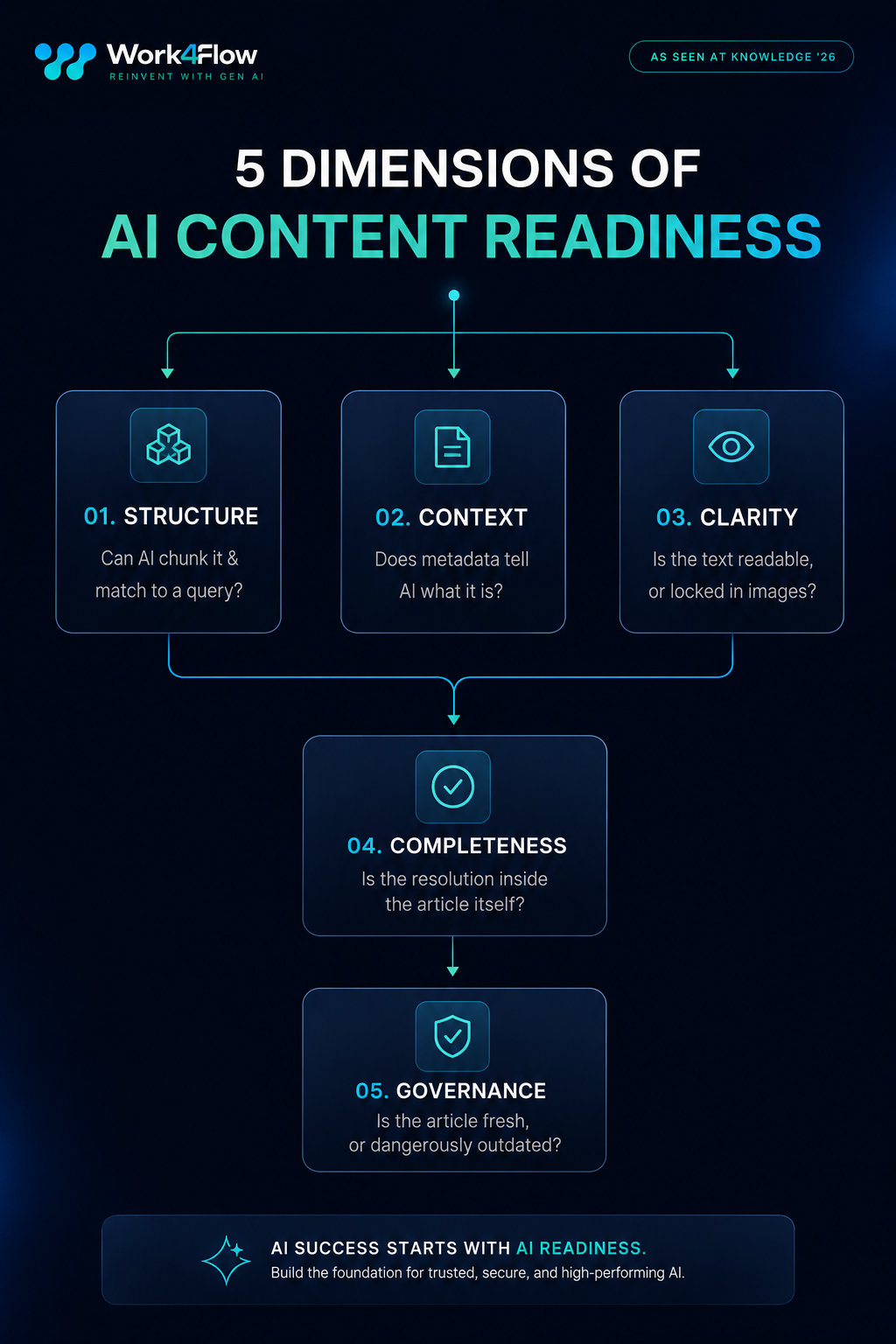
5 Core Dimensions of Content Readiness
1. Structure: Prose-Heavy, FAQ-Light
AI search engines perform best when articles are modular, utilizing headers and clear Q&A structures. Most legacy ServiceNow articles are written as walls of prose or narrative logs. Without logical chunking or semantic alignment, the AI cannot confidently map the document to a user's exact query.
2. Context: The Metadata Propagation Gap
Metadata dictates filtering and ranking. In ServiceNow's baseline study, over 150,000 articles missed critical metadata fields. Even when authors input this metadata, platform pipeline bugs often drop it before it reaches production. Without a release version, product classification, or audience tags, Now Assist cannot filter documents properly, leading to users receiving instructions meant for the wrong software version.
3. Clarity: Vague Titles and Monolithic Content
Every vague title is a missed retrieval, and every missed retrieval leads to a vague AI answer. Generic titles like "Support for developers" force the AI to rely on weak semantic signals. Furthermore, key instructions are often buried in unreadable formats, such as screenshots of error codes or non-standard code blocks, which parser engines fail to ingest cleanly.
4. Completeness: Missing Resolutions
Often, KB articles simply describe a known issue and point the reader to an external link, a closed incident ticket, or an attached PDF. Because Now Assist cannot comfortably navigate multiple layers of external references to compile a chat response, these articles are dead ends for generative AI.
5. Governance: Configuration Drift and Outdated Information
Outdated articles are toxic to generative AI. Traditional governance queues are slow, keeping content bottlenecked behind "approval theater.” Conversely, lack of automated validation allows configuration drift and legacy overrides to sit in production, serving expired policies to employees with absolute confidence.
How Work4Flow Remediates AI Gaps to Unlock Now Assist
A manual review of thousands of KB articles is logistically impossible. For example, fixing 75,000 vague titles manually would take content teams months of tedious work.
To solve this, Work4Flow deployed its Agentic AI Accelerators (including the AI Onboarding Hub and the Knowledge Article Optimizer). Rather than treating AI readiness as a one-time cleanup, Work4Flow implements an automated, continuous operating loop: Assess → Optimize → Measure → Repeat.
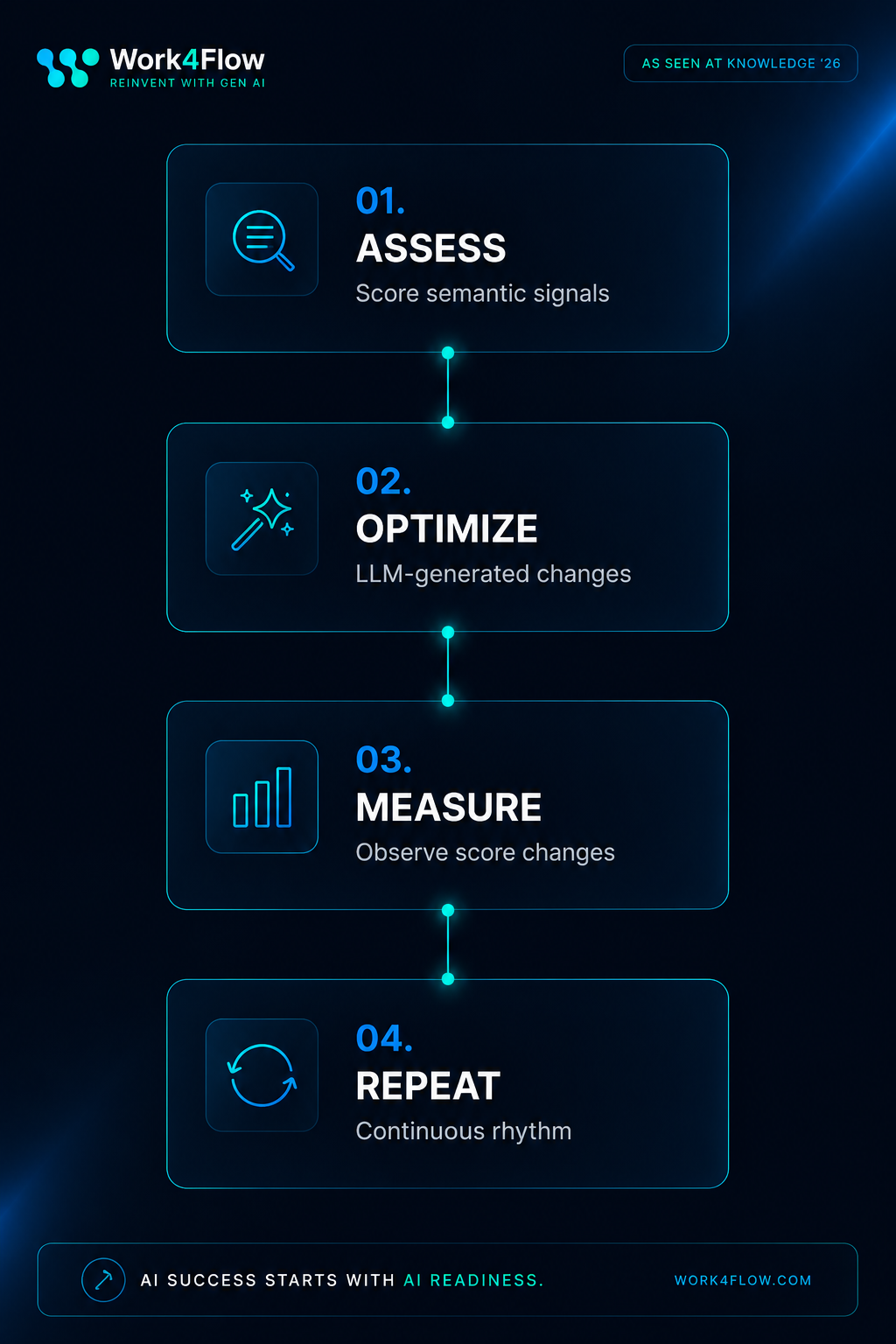
Work4Flow AI Remediation Operating Loop
Step 1: Assess (Revealing the Hidden Layer)
Work4Flow bypasses traditional static reports to deliver a live, prioritized stream of gaps based on semantic similarity scores.
The Diagnostic: It analyzes failed user searches and flags documents with a weak semantic signal (e.g., a similarity score of 0.42 out of 1.00).
The Insight: It highlights articles that exist but are written in a way the AI engine cannot understand or rank.
Step 2: Optimize (Smarter Content, Not Smarter Models)
You don't make Now Assist smarter by continually tweaking the LLM; you make it smarter by improving what it reads. Work4Flow's Knowledge Article Optimizer reads legacy articles and automatically generates optimized versions:
Structural Transformation: It converts dense prose into clear FAQs with logical markdown headings.
Title Enrichment: It scales LLM-driven title generation. For instance, a generic title like "Support for developers" is automatically re-written to "Support resources for ServiceNow developers"—aligning perfectly with user search patterns.
Metadata Inference: It deploys micro-LLMs to infer missing release, product, or audience metadata from the DITA source files or body text, instantly filling the pipeline gaps.
Step 3: Human-in-the-Loop Governance
Enterprise security demands strict control. Work4Flow’s platform operates on a Review → Approve → Apply model.
No Auto-Commits: Suggested title and structural optimizations are surfaced to knowledge owners via standard ServiceNow approval workflows.
Frictionless Compliance: It fits directly into standard enterprise governance models with a full audit trail maintained, avoiding the introduction of any "new approval theater".
Step 4: Measure (Tracking the Observable Chain)
Once approved changes are applied, Work4Flow immediately recalculates semantic similarity.
In real-world deployments (such as Adobe), the results of this loop were dramatic and highly visible in real time:
Semantic Signal Jump: Similarity scores rose from 0.42 to 0.82 for the same search queries.
Noise Reduction: Semantically aligned results returned first, meaning users no longer had to scroll through irrelevant search noise.
Faster Resolution: Employees got accurate, immediate answers from Now Assist, compounding into fewer re-queries, lower ticket escalations, and massive operational savings.
The Broader ServiceNow Instance Foundation: AION
AI content readiness is only part of the journey. To ensure that the wider ServiceNow instance is fully prepared to execute workflows, Work4Flow utilizes AION (the AI Onboarding Hub) to guide enterprises through a structured onboarding framework:
PLAN: Establish the foundational GenAI configuration baselines, execute discovery workshops, and prepare the environment.
REMEDIATE: Detect non-standard customizations, overrides, and configuration drifts, resolving the core technical blockers that make the instance unstable.
VALIDATE: Perform deep-dive catalog and workflow checks to confirm the instance meets the complex technical execution requirements of Now Assist skills.
OPTIMIZE: Continuously run the content optimizer and search relevancy engines to compound system performance over time.
Conclusion: Better Content In, Better AI Out
ServiceNow CEO Bill McDermott famously noted: “There is no artificial intelligence without human intelligence. It takes humans to unlock the value of AI.”
Now Assist is a world-class engine, but it is entirely dependent on the quality of the fuel you feed it. If your ServiceNow data is unstructured, un-indexed, and poorly contextualized, Now Assist will underperform with confidence.
Through Work4Flow, enterprises can finally measure their ServiceNow AI-readiness gap and automate its resolution at scale. By transforming legacy documentation into AI-optimized assets under human governance, you close the retrieval gap and allow Now Assist to deliver genuine, observable business value from day one.
Is your instance ready for the Agentic Era? Don’t guess. Let Work4Flow assess, optimize, and prove your readiness.
Continue exploring
See how this capability fits into your ServiceNow roadmap—features, rollout, and outcomes.